
I knew that Prescott was a veteran-friendly town steeped in rodeo and Wild West history but what I didn’t know until we moved here 5 months ago was just how many strong and brave heroes hailed from this mile-high, Arizona city.
As a U.S. Army veteran, I value and appreciate military history and traditions. From my recitation of the Flanders Field poem in Toastmaster speeches to my affinity for the symbolic red poppy, my active participation in the American Legion and VFW has increased my knowledge and awareness of the sacrifices so that so many U.S. servicemen and women have made for their country and in support of our allies across the globe.

I was delighted when I discovered that the American Legion post in Prescott, AZ was named after WWI pilot Ernest A. Love. The airport also bears this home-town hero’s name. What I didn’t realize until I attended a presentation by Air Force veteran and pilot, Dan Baier, at Yavapai College in November 2024, was just how powerful and Ernest’s story was. Mr. Baier was a master storyteller and brilliantly wove the letters, photos from the early 1900’s into an engaging historical and emotional experience that left few dry eyes in the auditorium.
Ernest A. Love is buried in Arlington National Cemetery due to the tenacious efforts of his mother, Etta, who did not wish to have her son laid to rest on enemy soil. What impacted me most about his story were the words engraved on this headstone which read:
“If I am to give my life for this cause, I am satisfied.
There is no way I’d rather go than serving my County.”
Wow, this hits hard and speaks to the loyalty and passion of this young American who graduated from Prescott High School in 1914 and enrolled in ROTC while at Stanford University. He was commissioned a 1LT and was sent to flight school and training in San Diego and then France.
Ernest was an exceptional aviator and flew 22 missions in two and a half months in France. His wood and canvas plane was a SPAD 13 and he was killed in action on September 15, 1918 and his last letter to his Mom, Etta in Prescott was dated September 12th. This letter was not signed.
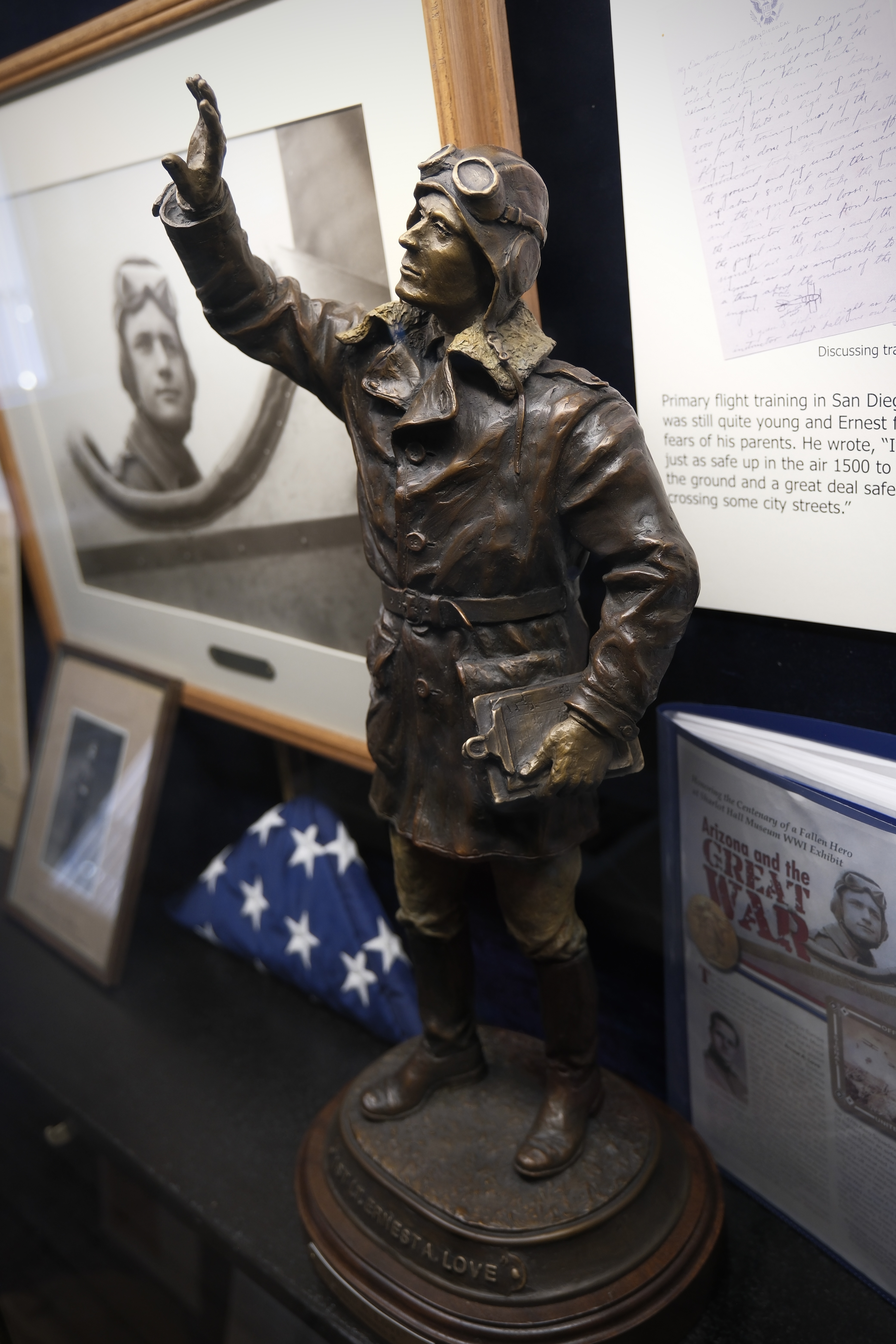
So many heartfelt letters were exchanged during this time and they are archived and shared at the Sharlot Hall Museum as well as in the display case at the American Legion Post in Prescott, Arizona.
Love of Country. Support of Veterans.
One hundred-five (105) years ago, the American Legion and the Ernest A. Love Arizona Post 2 (later to become Post 6), were founded.
The four pillars of Veteran’s Affairs & Rehabilitation, Americanism, National Defense, and Youth & Children are still the guiding principles of the nation’s largest veteran organization.
On a local level in Prescott, the post has been vibrant center of activity and support for veterans, families, scouts, and students. Since getting their physical post home on 202 S. Pleasant Street in 1930, the post has hosted countless dances, dinners, social and community events.
American Legion was chartered by the U.S. Congress in September of 1919 and the Prescott Post was named after Ernest A. Love that year.
By all accounts Ernest loved his country. He was friendly, helpful and optimistic about life in America. He was a Boy Scout, supportive son, and neighbor.
I am proud that members of Legion Post 6 and its family of chapters (Auxiliary, Sons of the Legion, and Legion Riders) pay tribute and respect to those who gave up their lives to defend freedom and liberty.

I am proud the American Legion helps veterans, families, and students in their communities.
I am proud that a group of U.S. soldiers stationed in France after WWI came up with the idea to start this organization to increase the low morale of the war-weary troops.
I am motivated and inspired by Ernest A. Love’s story of duty and honor which are forever inscribed in white marble stone in Arlington:
I am proud that I am a member, and now officer, of the American Legion post in Prescott that is named Ernest A. Love Post 6.
“There is no way I’d rather go than serving my Country.”
Prescott’s hometown hero has a life-sized statue of him outside of the local airport which bears his name. He also has a large memorial display of photos, letters, military service caps, and a burial flag in the main hall of American Legion Post 6 on South Pleasant Street and it was honor to share his story with you.

When love is earnest, it is all the more powerful with its sincere and intense conviction.
1LT Love showed us this in the fields of France in 1918 and his spirit and dedication to country lives on in the extended family of the American Legion.


 Strong Words & Simple Truths