Wreaths to Remember

Remember. Honor. Teach.  This is the mission of Wreaths Across America.

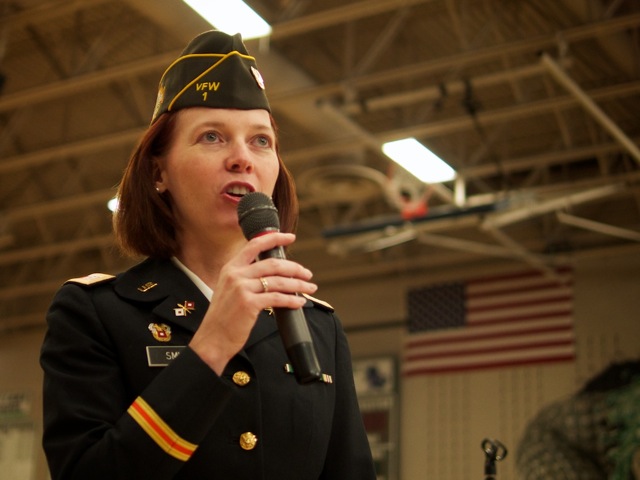
I was honored to present the U.S. Army Wreath at this powerful event which took place at the Prescott National Cemetery, Arizona on December 13, 2025. 

Gold Star families, Boy Scout troops, Young Marines, Cadets, the Ernest A. Love Post 6 Honor Guard, the Legion Riders, along with numerous VFW and American Legion posts and family chapters, volunteered and supported the effort.

The Ernest A. Love Post 6 Honor Guard

Prior to this year, I was vaguely aware of this annual wreath-laying ritual, but I had no idea of the vast scope, scale and impact of it. 

To remember the fallen, to honor those who serve and to teach the next generation the value of freedom.  This is what I learned were the true passion and meaning behind Wreaths Across America and I was proud of my community and fellow veterans for coming out and showing their support.

Combat Vets Association Volunteer unloading wreaths at Prescott National Cemetery

To appreciate the immense scope of this event, I went to the organization’s website and saw that more than 2 million volunteers and supporters who gathered to Remember, Honor and Teach at more than 5,500 locations in all 50 states, at sea and abroad.   I was impressed to learn that wreaths were presented and laid at the gravesites of our WWI and WWII fallen in all 26 American cemeteries overseas including Normandy, Cambridge, Luxembourg, Monilia, Sicily-Rome, Belgium, the Netherlands, Panama and Tunisia.

It was comforting to me to know that our servicemen and woman who died overseas are not forgotten.
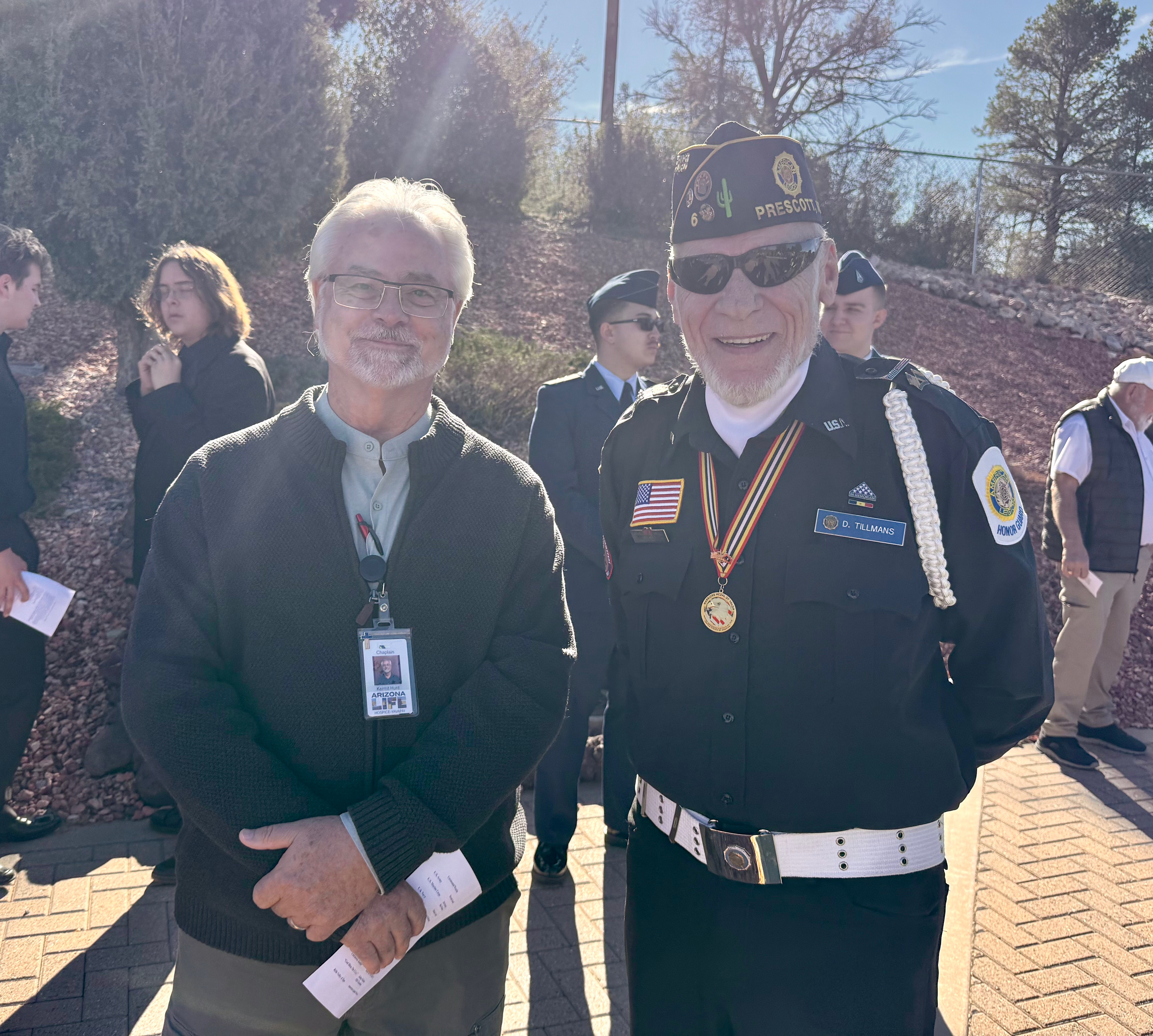
Kermit Hunt and Dan Tillmans

The Christmas and Hannukah season are a challenging time for active-duty military and their families.  It is especially challenging for Gold Star families who lost loved ones.

Veterans present U.S. Army, Marine and Navy wreaths

It is my hope that this annual ritual will bring some warmth and comfort to the many who are grieving. 

It is my hope that the act of laying a wreath or placing a stone on a gravesite while taking a moment to say the veteran’s name out loud will bring some peace to the families because their loved one is not forgotten.  

All five of my senses were strongly engaged during the Wreaths Across America event—the visual presence of red bows, the sound of the bugler playing Taps, the scent of pine, the taste of hot chocolate prepared by volunteers, and the warmth of greetings exchanged with fellow veterans.
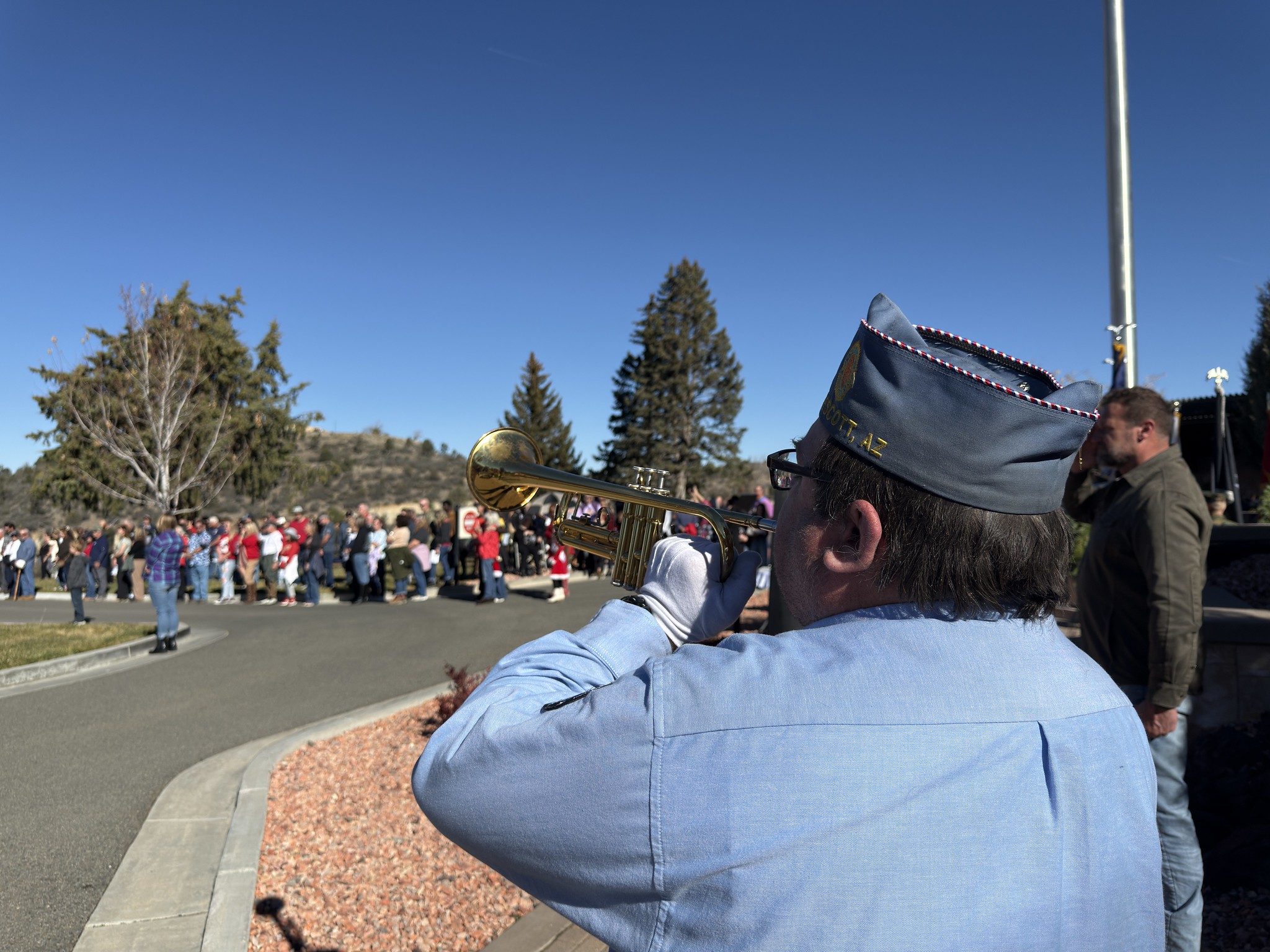
Elliott from American Legion Post 6 sounds Taps

Thank you to all volunteers and supporters who helped make this event possible across America and at our cemeteries abroad.

Respect, Honor and Tributes: A Flag Day to Remember

Respect, Honor and Tributes: A Flag Day to Remember

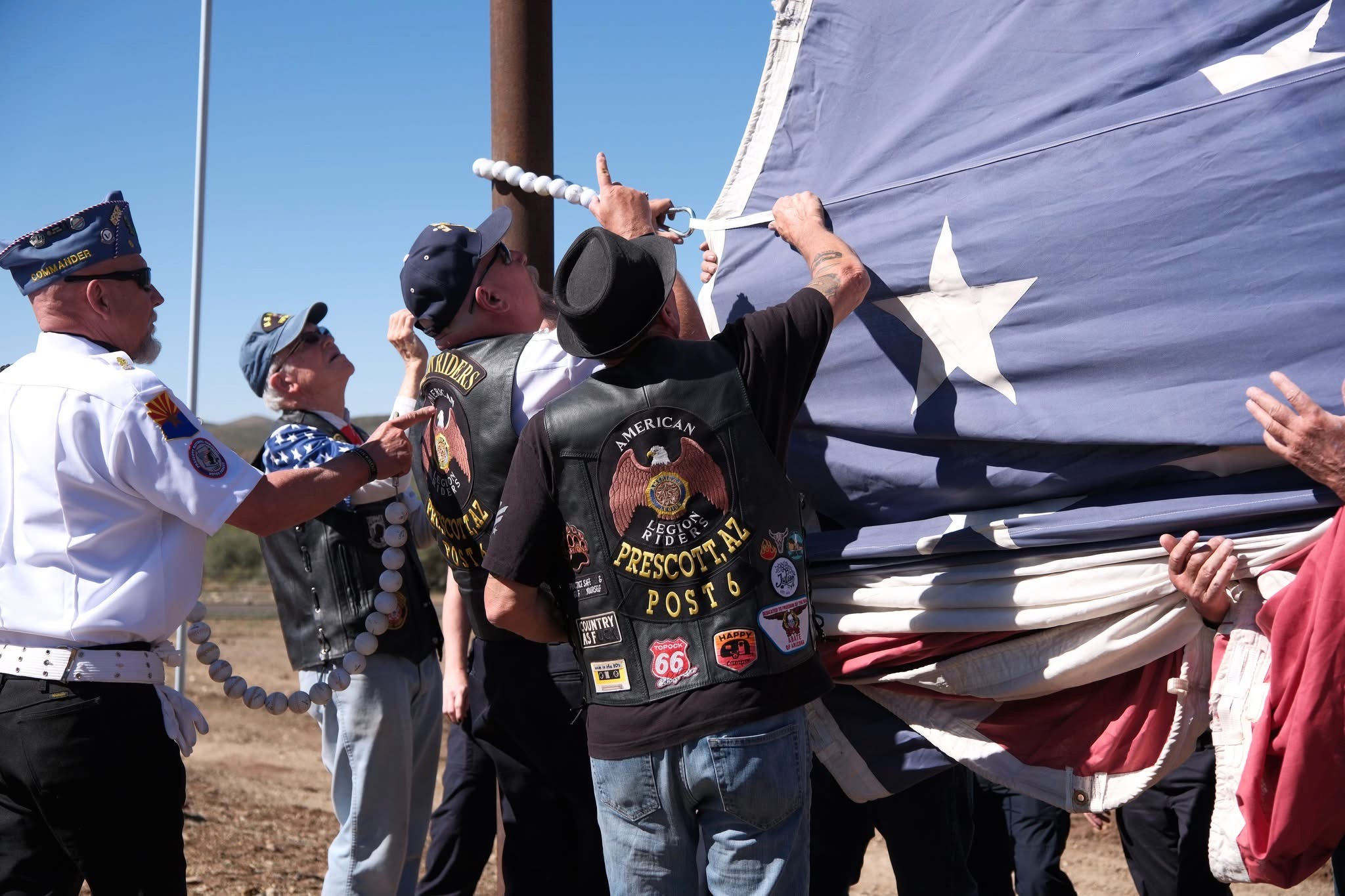
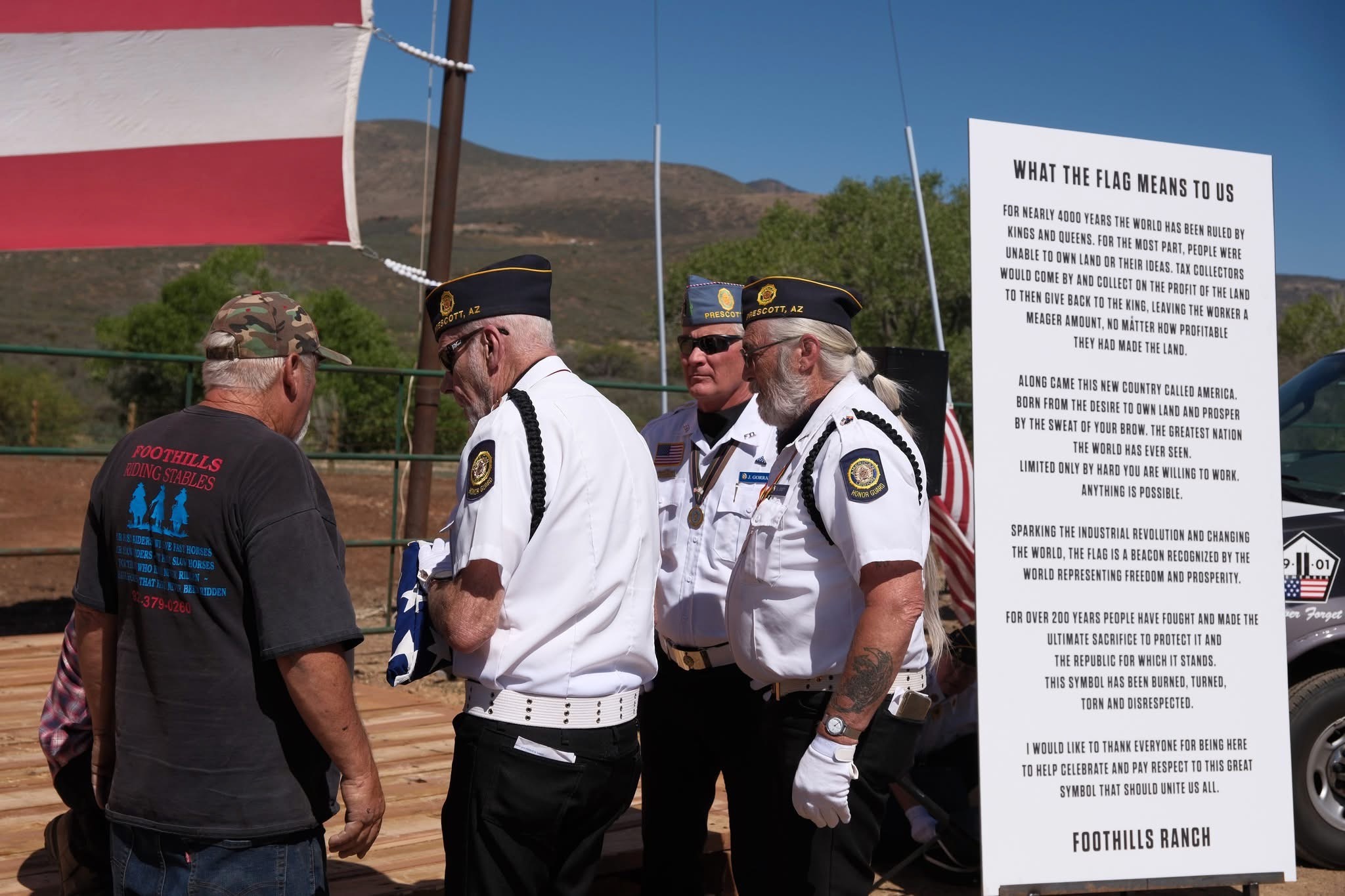
It was a Flag Day to remember for reasons I did not realize when my husband and I ventured out to Mayer, AZ on the morning of June 14, 2025. It was a temperate and not so windy Saturday and the people who gathered at the Foothills Ranch were glad for it. A huge American flag was raised in honor of many things: the U.S. Army’s 250th birthday, Flag Day, and a Missing Rider tribute to a fellow American who spearheaded this event in prior years.

Video by Dave the Drone Guy, Dave Smithwick

A poignant flag retirement ceremony was held thanks to the dedication and hard work of Foothills Ranch owners Wes and Phyllis Holmes. Numerous organizations also contributed to the effort by volunteering and donations, including local Boy Scout Troops, American Legion Posts and family chapters from Prescott, Cottonwood, Chino Valley, and Humboldt, the Ernest A. Love Post 6 Honor Guard, American Legion Riders and local businesses (see below for more details on that part of the story).

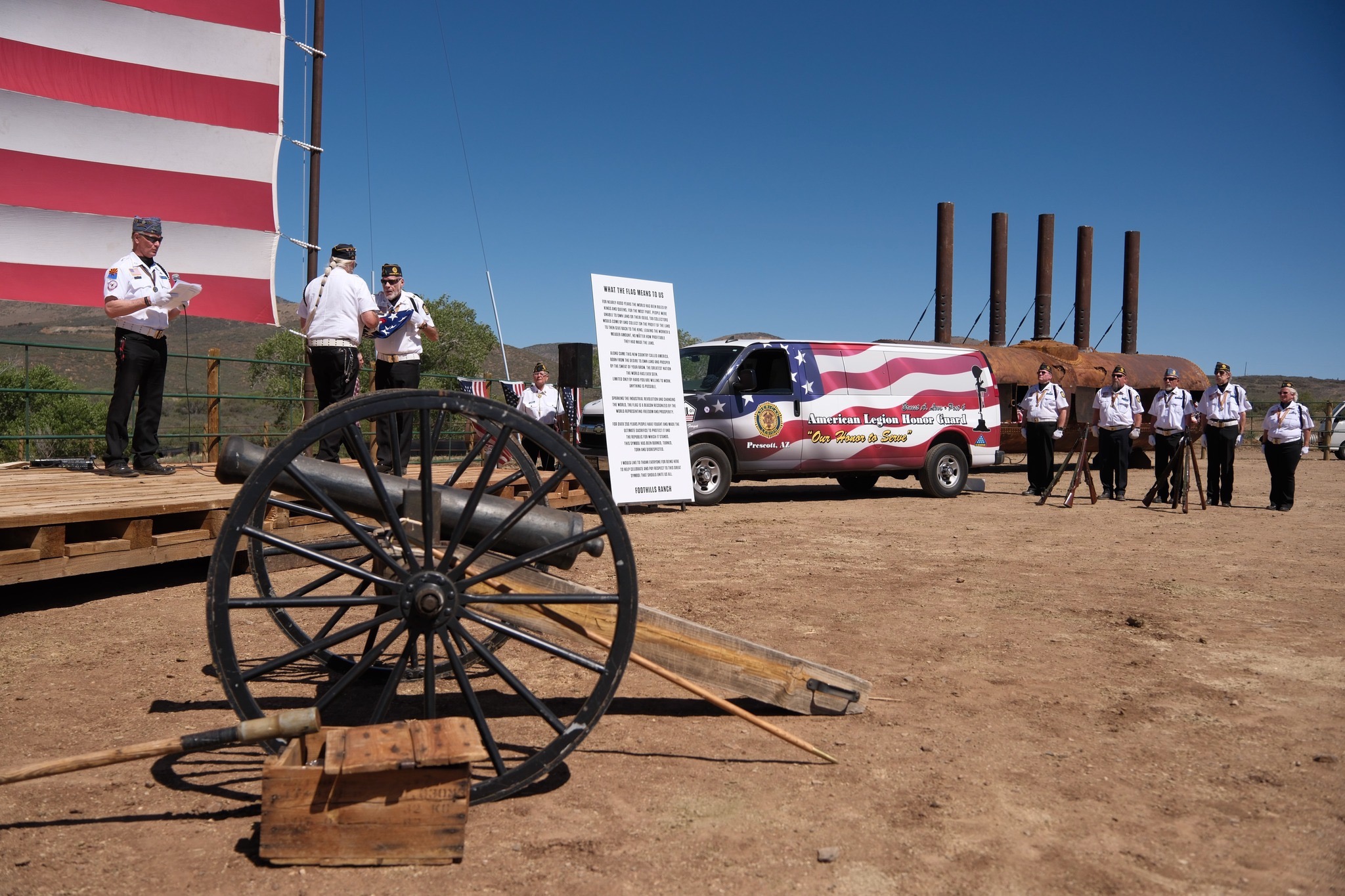
A tall white sign with the title What The Flag Means to Us shared what U.S. Stars and Stripes represented to hosts for the day’s event.  Wes Holmes stated, “ I believe it is sacred and should be treated with respect. This is why we host the retirement ceremony- to ensure these flags receive the honor they deserve.”

l. to r. Wes Holmes, Dan Tillmans, Joe Gorraiz, and Sherm Scott. Photo by Steve Smull

The event was powerful and impactful with many moving words, prayers, symbols, and traditions.

What started two years ago with two friends, Mark Meridith and Wes Holmes has grown to a large and amazing event. 

Why hold such an event?

  1. Respect for the symbol of our nation.  Respect for the memory of our family and friends who have passed.  
  2. Honor for those who have served and sacrificed for their country.

Yavapai County is home to many military veterans and patriotic residents, resulting in a significant number of flags that require proper disposal each year. According to the U.S. Flag Code, a worn-out flag should not be placed in a landfill and is recommended to be destroyed in a dignified manner, preferably by burning.

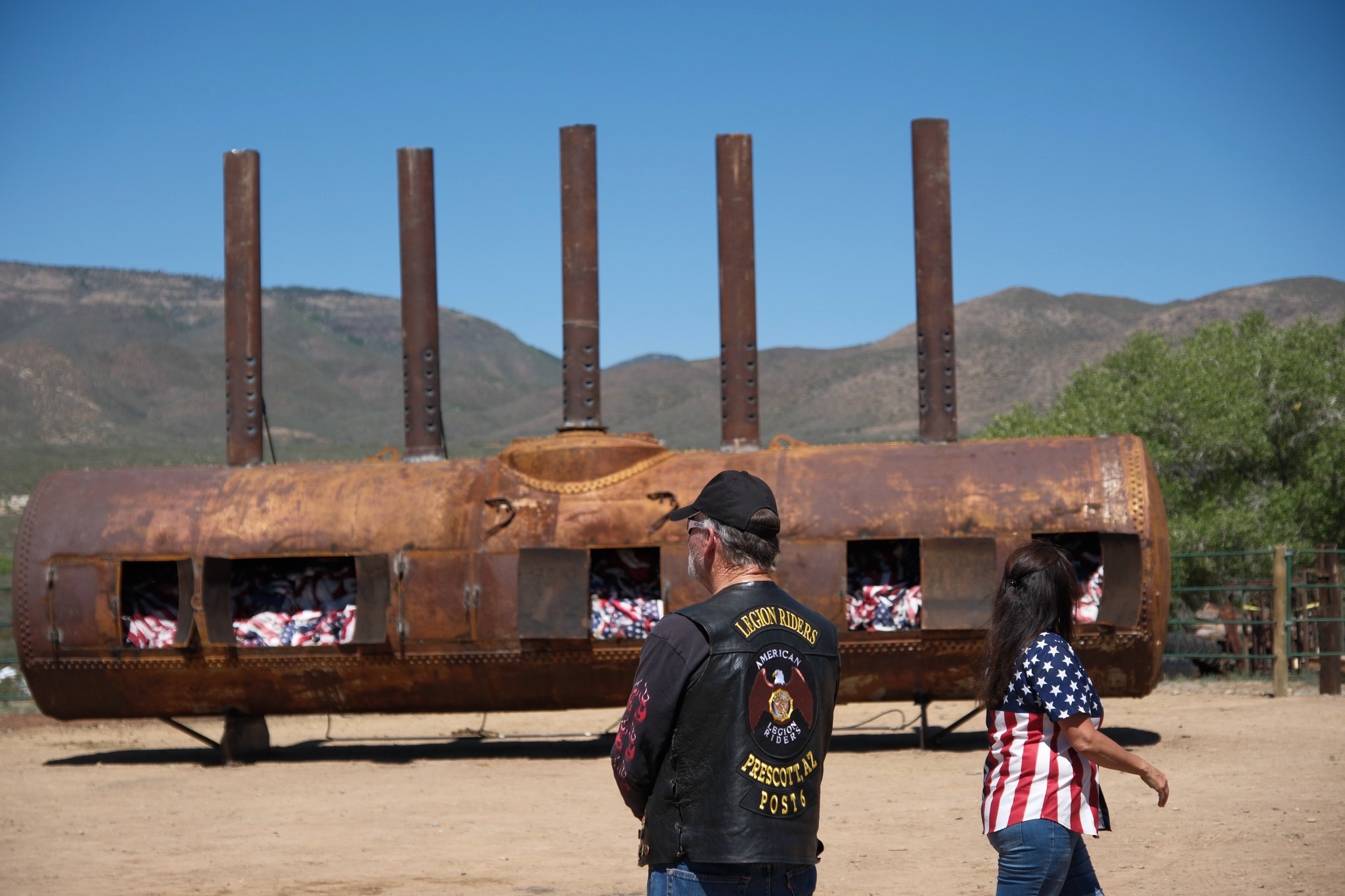
The newly built Flag Incinerator. Photo by Steve Smull

What I didn’t know while I was enjoying and appreciating the Flag Day ceremony at Foothills Ranch that day was just how much work, time, sweat, and effort went into it.  Being there in person you could feel how much emotion and passion were poured into the proceedings.

Seeing a beautiful horse named Cash being led out by Phyllis was a touching Missing Rider Tribute to Mark Merdith who passed away six months prior.  Wes gave a heartfelt announcement to those gathered that morning for the ceremony about his friend who was a driving force for the special Flag Day event and asked for a moment of silence.  It was a moving and powerful moment I will never forget.

Cash, Phyllis Holmes, and the Post 6 Honor Guard. Photo by Steve Smull

The American Legion Post 6 Honor Guard played a pivotal role in the Flag Day traditions. Their flag folding ceremony, gun salutes, and sounding of taps presented honor and respect to our nation’s flag as well those who sacrificed their lives for it.

Photo by Steve Smull

The other striking and impressive element of Flag Day 2025 was the large, rusty brown incinerator with its five 9ft chimney stove pipes.  Prior to the flag retirement ceremony, the five hand-welded doors of the converted oil tanker were flung open to reveal over 3,000 flags stacked high.

Photo by Steve Smull

The events leading up to the creation of the incinerator is a story of collaboration, persistence, and generosity.   Plato’s words “Necessity is the Mother of Invention” came to mind when Wes recounted the genesis of the old 33ft railroad tanker car.  There were two main reasons why Wes envisioned the need for an enclosed structure to ignite the flags- the wind and the large number of flags needing disposal (the 2024 flag retirement in a small, open burn pit had to be cancelled due to high winds).

Two weeks prior to the event on 6/14/25, Wes made a call to the Director of the Post 6 American Legion Riders (ALR) stating that if they didn’t get the funds to purchase the oil tanker then the Flag Retirement ceremony would need to be cancelled.  That is when Sandra Tavares, ALR Director in Prescott sprang into action and worked with the Commander and other family chapters of the Ernest A. Love Legion post to pull together the donations needed for Wes to acquire the oil tanker he found on Facebook Market place.  Now he had to drive his truck and trailer to over 375 miles to St George, Utah to pick the 13,000 lb steel metal tank.  It was a harrowing trip back as the length and weight of the tank upset the balance of the trailer.

Once Wes got back to Arizona, multiple local businesses donated steel, stove pipes, welding supplies as teams of welders and other craftsmen provided many hours of skilled labor to rapidly build the incinerator just in time for the big event.

Phyllis and Wes Holmes. Photo by Steve Smull

The following businesses and organizations donated money, supplies and time to the make Flag Day 2025 in Mayer, Arizona a reality.

  • Lamb Chevrolet
  • Mayer Fire Department
  • Ernest A. Love Post 6 Honor Guard- Dan Tillmans, Sherm Scott, Rich Fuller, Joe Gorraiz, Peggy Schmidt, Rich Tuten, Neal Goforth, Dirk Thayer, and Bugler Dede Dexter from Post 25.
  • Ernest A. Love American Legion Post 6 with ALR, Auxiliary, and Sons of the American Legion
  • American Legion District 8
  • RBS Fab LLC
  • Superior Industries
  • Yavapai Steel
  • Bill Roberts
  • Tom Lowe
  • Jeff Smith
  • Stewart Phelan
  • Yavapai Bottle Gas
  • Ron Lipps
  • Ryan Richard – RR Welding Services
  • Dave Smithwick, https://davethedroneguy.com
  • Boy Scout Troop 303
Photo by Steve Smull

The Flag Day 2025 event was a passionate and patriotic experience with prayers, the raising of a large 50×30 ft American Flag, cannon blasts, honor guard services, singing of our National Anthem, Missing Rider tribute, U.S. Flag Retirement ceremony, and the emotional sounding of taps.  

After the ceremony, attendees enjoyed a BBQ brisket meal compliments of  Phyllis Holmes and American Legion Post 6 family chapters.

Photo by Steve Smull

Thank you to everyone who contributed, supported and attended this meaningful holiday service.  

The honor, respect, and heartfelt tributes made it a Flag Day to remember!

Photo by Steve Smull

American Legion Auxiliary raises thousands to help veterans in Prescott, AZ

The Auxiliary members of the Ernest A. Love Unit 6 American Legion extend their sincere thanks to everyone who generously donated during their annual Poppy drive this year.

Auxiliary Unit 6 Officers Diane Shaffer and Sandy Gorraiz

Armed with bright, red poppies and warm smiles, twelve members of the Unit 6 Auxiliary set up tables outside of True Value and two Fry’s locations in Prescott, AZ.  The goal of the annual campaign around Memorial Day is to not only raise awareness but to raise money for local veterans.  This year the team received $2,148 in donations.

This tradition, deeply rooted in history and patriotism, invited the Prescott community to show their support for veterans while contributing to meaningful programs that directly benefit them and their families.

The Significance of the Poppy

The iconic red poppy has long been a symbol of remembrance and resilience. Its history dates back to World War I, inspired by the poignant poem “In Flanders Fields” written by Canadian soldier John McCrae. The poppy grew in the battlefields of Europe, blooming amidst the chaos and destruction, and it became a powerful emblem of sacrifice and hope. The American Legion Auxiliary adopted the poppy as a tribute to the courage and sacrifices of veterans and as a beacon of support for those who continue to serve.

Supporting Veterans Through Donations

Every poppy distributed by the American Legion Auxiliary represents a story of bravery and endurance. Donations collected during poppy campaigns directly fund programs designed to assist veterans, military families, and active duty servicemembers. These funds help maintain critical services such as rehabilitation programs, housing assistance, job placement initiatives, and mental health support.

In Prescott, the Ernest A. Love Unit 6 Auxiliary is committed to making a difference by channeling donations into local and national efforts that uplift the lives of those who have sacrificed for freedom. When you wear a poppy, you stand as a testament to their service and affirm your dedication to remembering their contributions.

Auxiliary Unit 6 President Glenda McFarland and Connie Turner.

When Love is Earnest

I knew that Prescott was a veteran-friendly town steeped in rodeo and Wild West history but what I didn’t know until we moved here 5 months ago was just how many strong and brave heroes hailed from this mile-high, Arizona city.

As a U.S. Army veteran, I value and appreciate military history and traditions. From my recitation of the Flanders Field poem in Toastmaster speeches to my affinity for the symbolic red poppy, my active participation in the American Legion and VFW has increased my knowledge and awareness of the sacrifices so that so many U.S. servicemen and women have made for their country and in support of our allies across the globe.

Photo by Steve Smull

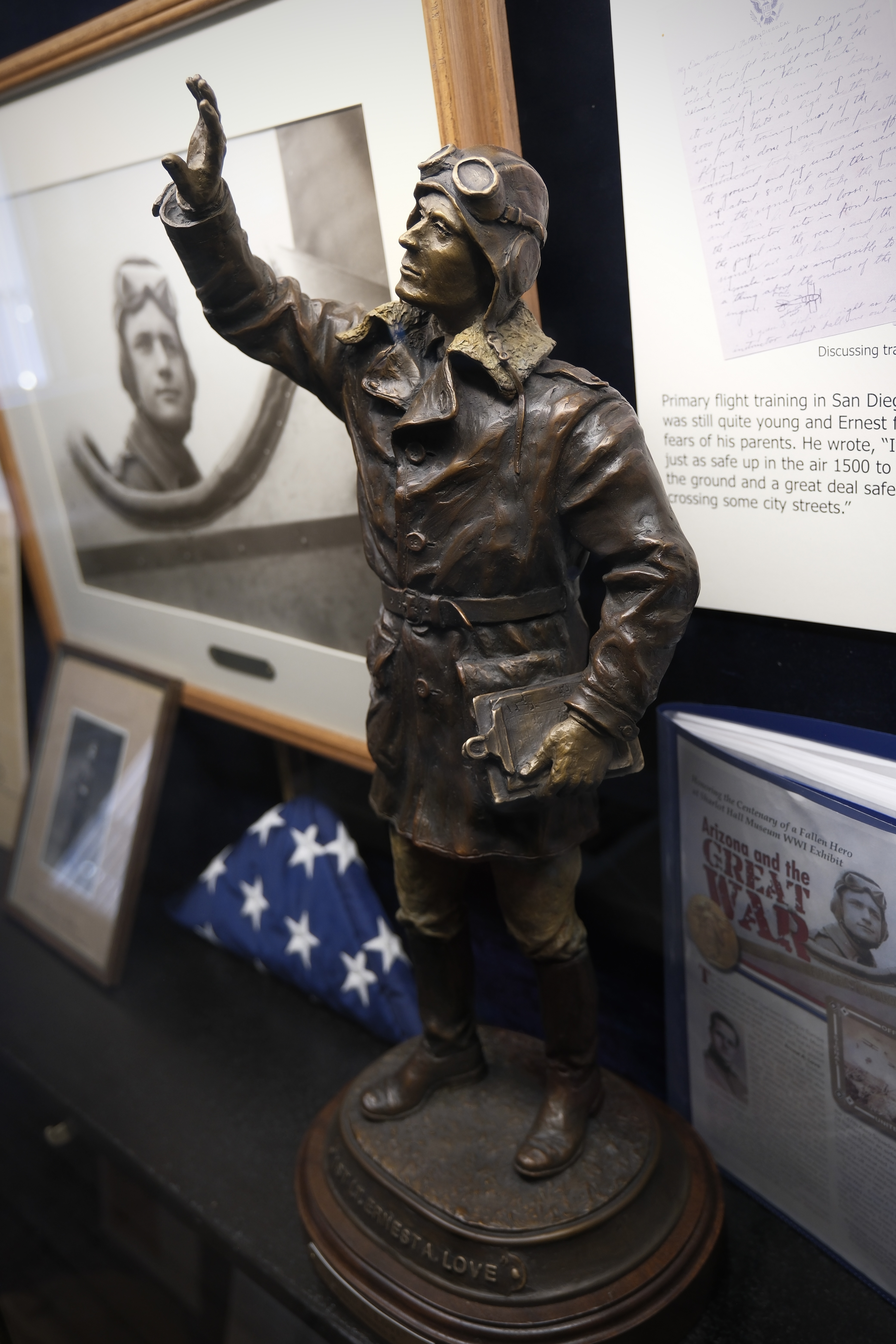
I was delighted when I discovered that the American Legion post in Prescott, AZ was named after WWI pilot Ernest A. Love. The airport also bears this home-town hero’s name. What I didn’t realize until I attended a presentation by Air Force veteran and pilot, Dan Baier, at Yavapai College in November 2024, was just how powerful and Ernest’s story was. Mr. Baier was a master storyteller and brilliantly wove the letters, photos from the early 1900’s into an engaging historical and emotional experience that left few dry eyes in the auditorium.

Ernest A. Love is buried in Arlington National Cemetery due to the tenacious efforts of his mother, Etta, who did not wish to have her son laid to rest on enemy soil. What impacted me most about his story were the words engraved on this headstone which read:

“If I am to give my life for this cause, I am satisfied.

There is no way I’d rather go than serving my County.”

Wow, this hits hard and speaks to the loyalty and passion of this young American who graduated from Prescott High School in 1914 and enrolled in ROTC while at Stanford University. He was commissioned a 1LT and was sent to flight school and training in San Diego and then France.

Ernest was an exceptional aviator and flew 22 missions in two and a half months in France. His wood and canvas plane was a SPAD 13 and he was killed in action on September 15, 1918 and his last letter to his Mom, Etta in Prescott was dated September 12th. This letter was not signed.

So many heartfelt letters were exchanged during this time and they are archived and shared at the Sharlot Hall Museum as well as in the display case at the American Legion Post in Prescott, Arizona.

Display case at Legion Post 6 in Prescott, AZ. Photo by Steve Smull

Love of Country. Support of Veterans.

One hundred-five (105) years ago, the American Legion and the Ernest A. Love Arizona Post 2 (later to become Post 6), were founded. 

The four pillars of Veteran’s Affairs & Rehabilitation, Americanism, National Defense, and Youth & Children are still the guiding principles of the nation’s largest veteran organization. 

On a local level in Prescott, the post has been vibrant center of activity and support for veterans, families, scouts, and students. Since getting their physical post home on 202 S. Pleasant Street in 1930, the post has hosted countless dances, dinners, social and community events. 

American Legion was chartered by the U.S. Congress in September of 1919 and the Prescott Post was named after Ernest A. Love that year. 

By all accounts Ernest loved his country. He was friendly, helpful and optimistic about life in America. He was a Boy Scout, supportive son, and neighbor. 

I am proud that members of Legion Post 6 and its family of chapters (Auxiliary, Sons of the Legion, and Legion Riders) pay tribute and respect to those who gave up their lives to defend freedom and liberty.

I am proud the American Legion helps veterans, families, and students in their communities.

I am proud that a group of U.S. soldiers stationed in France after WWI came up with the idea to start this organization to increase the low morale of the war-weary troops.

I am motivated and inspired by Ernest A. Love’s story of duty and honor which are forever inscribed in white marble stone in Arlington: 

I am proud that I am a member, and now officer, of the American Legion post in Prescott that is named Ernest A. Love Post 6. 

“There is no way I’d rather go than serving my Country.”

Prescott’s hometown hero has a life-sized statue of him outside of the local airport which bears his name.  He also has a large memorial display of photos, letters, military service caps, and a burial flag in the main hall of American Legion Post 6 on South Pleasant Street and it was honor to share his story with you. 

Post 6 Members Lou Cappadona, Brenda Smull & John Boyer. Photo by Steve Smull

When love is earnest, it is all the more powerful with its sincere and intense conviction.

1LT Love showed us this in the fields of France in 1918 and his spirit and dedication to country lives on in the extended family of the American Legion.

Photo by Steve Smull

Display case in the hall of Legion Post 6 in Prescott, AZ. Photo by Brenda Smull

Will We Ever Learn?

Do human beings learn from their mistakes?

It doesn’t seem so.

I’m observing that many people on this earth are continually repeating negative patterns and unproductive behaviors.  There doesn’t seem to be much adaptation or changing of course when mistakes are made.   Learning from our mistakes and adjusting how we approach a situation is not a common occurrence today.  Perhaps it is because we humans tend to base our decisions more on feelings and emotions rather than logic and facts.   Can you ever really “learn” from a feeling?

I wrote the blog below ten years ago in May 2014 and I’m sad to say the sentiment is still valid today.  The title “Leadership Challenges in Non-Profit Organizations” is a continuous issue for another who volunteers or is elected to an Officer.  

My observations and recommendations on these phenomena also apply greatly to our local, state and federal leaders.  

Leadership Challenges in Volunteer Organizations.  

Published online on May 30, 2014.

Strong leaders are critical to the success of any organization- be it a non profit,  a corporation, a military unit,  a church or a bicycle club.   I believe that successful leaders can be developed and nurtured through mentoring, coaching and training but I have recently witnessed how unchecked power and bloated egos can corrupt leaders of volunteer groups.   Over the last 20 years, I’ve been a member and/or officer in numerous nonprofit and corporate organizations and have seen a negative trend in leadership ethics.

Since college I have had the honor and privilege of serving under many inspirational officers, managers and executives who truly embodied the values of respect, humility and service.   These altruistic and motivational men and women were my role models and taught me the importance of recognition, encouragement, honesty and integrity.   They taught me to stay focused on the team member’s needs above my own.

In the past few years, I have become concerned by the increase in the frequency and negative impact that “corrupted” leaders are having on their organizations (this is across the board in society-  from the local nonprofit and school board to the state and federal governments).   There are more power-influenced leaders today and fewer selfless ones. There is more Me and less We and that’s not the way it should be!  Another disappointing theme I’ve observed recently is a misplaced focus where the officers of organizations are more concerned about their own power, titles and agendas with little priority or attention given to the actual members.

I recently wrote a speech and created a presentation entitled “Leadership Challenges in Volunteer Organizations”  where I outlined issues, impediments and possible solutions to address membership growth and retention concerns in non profit groups like Toastmasters and the VFW.   I sadly will cite the destructive and non-collaborative behaviors of power trips, politics and petty personal attacks as key factors negatively impacting the morale and growth of many well meaning, non-profit groups.

Solutions to these issues are often difficult to implement in a broad sense since they need to come from within the individual leaders however,  a positive organizational culture coupled with strong team agreements can go a long way toward improving a group’s leadership challenges.   An unwavering commitment to the organization’s  core Mission, without compromise, is also a critical to ensuring that ethical leaders are rewarded, encouraged and attracted.

Here are the Mission Statements of two organizations I am a member of:

“Provide a supportive and positive learning experience in which members are empowered to develop communication and leadership skills.”

 “ To serve our veterans, the military and our communities.  To advocate on behalf of all veterans.”

Notice that nowhere in the statements above does it mention the role, power or importance of the leaders or officers of the group.  They are solely focused on the members of the organization.  Losing sight of this simple fact is what I believe is causing many of the leadership issues we see in our volunteer organizations today.

Perhaps this message and blog can reach others and be shared in order to make a positive impact in our communities and non-profit groups.  I hope so!

Red Poppies are Not Artificial

The red poppy is a real and hardy flower that thrives in Belgium, France, England, and along the streets of Georgetown, Texas. This vibrant wildflower is a strong and passionate symbol of the sacrifices made by members of the armed forces across Europe, Canada, and the United States.

Poppies are authentic.

Poppies are powerful.

Poppies are the perfect reminder of the true meaning of Memorial Day in the United States.  A stark and true symbol of remembrance and hope.

I first learned about the poppy when I was 10 years old and competing in my local VFW Post’s Poppy Queen contest.  Having studied the history and background of the red and black flower, I have grown to appreciate its beauty and enduring symbolism.  While paper replicas of the Papaver roheas are hand-crafted and distributed outside thousands of grocery stores on Memorial Day weekend in the U.S., they are not artificial.  Rather, they represent the truest of all human experiences – that of noble sacrifice for one’s country.

It is an honor to don a red poppy in remembrance for those who have served in the military and paid the ultimate price.

The last stanza of the famous WWI poem, In Flanders Field, strikes me in my heart every time I read or recite it:

Take up our quarrel with the foe

To you from failing hands we throw

The torch;  be yours to hold it high.

If ye break faith with us who die.

We shall not sleep, though poppies grow

 In Flanders Field.”

The reality of humankind’s warlike ways is painfully evident across the globe and the valiant fight of good against evil continues.   The simple red poppy remains a strong and radiant light of truth, power and sacrifice.  Nothing is more real than that.


An Honor to Serve: Veterans Helping Veterans

In the United States, November 11th is the national holiday when we recognize our fellow citizens who have served their country in the military.  Veterans Day, unlike Memorial Day, is meant to appreciate the sacrifices of the millions of living veterans who raised their right hand and pledged to defend the U.S. Constitution against all enemies, foreign and domestic.  

This year Veterans Day has more meaning for me than usual.  With the active and brutal battlefields in the Middle East and Eastern Europe, I am acutely aware and distressed at the heavy price that is being paid by both military personnel and civilians during wars.  

As a U.S. Army Veteran from the Gulf War, it my honor to serve as the Commander of Ahwatukee American Legion Post 64 which is focused on helping veterans and their families in our local community. 

Now more than ever, we need to strengthen the social fabric of our society and in our neighborhoods and, in my opinion, this is best done by connecting and bonding with people in person with a sense of common purpose.  One of the things I miss most about my time in the military is the camaraderie and sense of shared values with fellow service members.  When in a foxhole together at the morning stand to during my deployment in Saudi Arabia and Iraq, it didn’t matter what color your skin was or what your religious beliefs were.  The only thing that mattered was that you were an American and believed in freedom, liberty, and our country’s Constitution.  

As part of our Post’s Veterans Helping Veterans initiative, we are conducting Buddy Checks, where American Legion members are actively calling members to check in and see how they are doing. We are letting veterans know that we miss them and are thinking about their health and wellbeing. This focus is in support of the American Legion’s “Be the One” program, a suicide prevention effort which is addressing the growing health concern among those who served and are suffering with PTSD, TBI, or other debilitating issues.

American Legion Post 64 is Ahwatukee’s sole Veteran’s Service Organization and we meet monthly (3rd Wednesdays at 4PM) at the Ahwatukee Recreation Center (ARC).  This November 11th you can visit with veterans from Post 64 at our table at the 19th Annual Ahwatukee Car Show on 4700 E. Warner Rd.  

Please visit our website at www.americanlegionpost64.com for more information on the many events and social activities we are hosting in the local area.

Happy Veterans Day!

Keeping the Faith with Poppies in May

May is the month for poppies in the U.S.A.   These simple, red flowers represent so much passion and emotion that I often marvel at their worldwide impact.  Millions of members and supporters of veteran organizations like the American Legion and the VFW distribute handmade paper poppies in the lead up to Memorial Day (the last Monday in May was declared a U.S. federal holiday in 1971). 

For almost 100 years, the poppy has been a powerful symbol of remembrance, respect and honor for military veterans in the UK, Canada, France, Belgium, Australia, New Zealand, and the United States.

For many, the red poppy represents sacrifices made in the defense of freedom.

Photo by Brenda Smull

For me, the month of May is a time of solemn tributes and memorial services for veterans who have lost their lives while serving their country and more personally, for my father, who passed away on May 2, 2003.

Fifteen years ago this month, I gave an impassioned speech at the Austin Toastmasters club titled “In Flanders Fields”.  I opened with a recitation of the powerful World War I poem by Canadian Lt Col. John McCrae and told stories of how important the red poppy and the solemn Memorial Day traditions are to me and my family.  

This year I share an excerpt of the poem “We Shall Keep the Faith” written by an American woman named Moina Michael in 1918.

We cherish, too, the poppy red
That grows on fields where valor led;
It seems to signal to the skies
That blood of heroes never dies,
But lends a lustre to the red
Of the flower that blooms above the dead
In Flanders Fields.

Photo by Steve Smull

In keeping with the spirit of this poem and the opening thoughts of this article, below is a portion the First Vice Commander report I submitted for my American Legion Post’s newsletter.

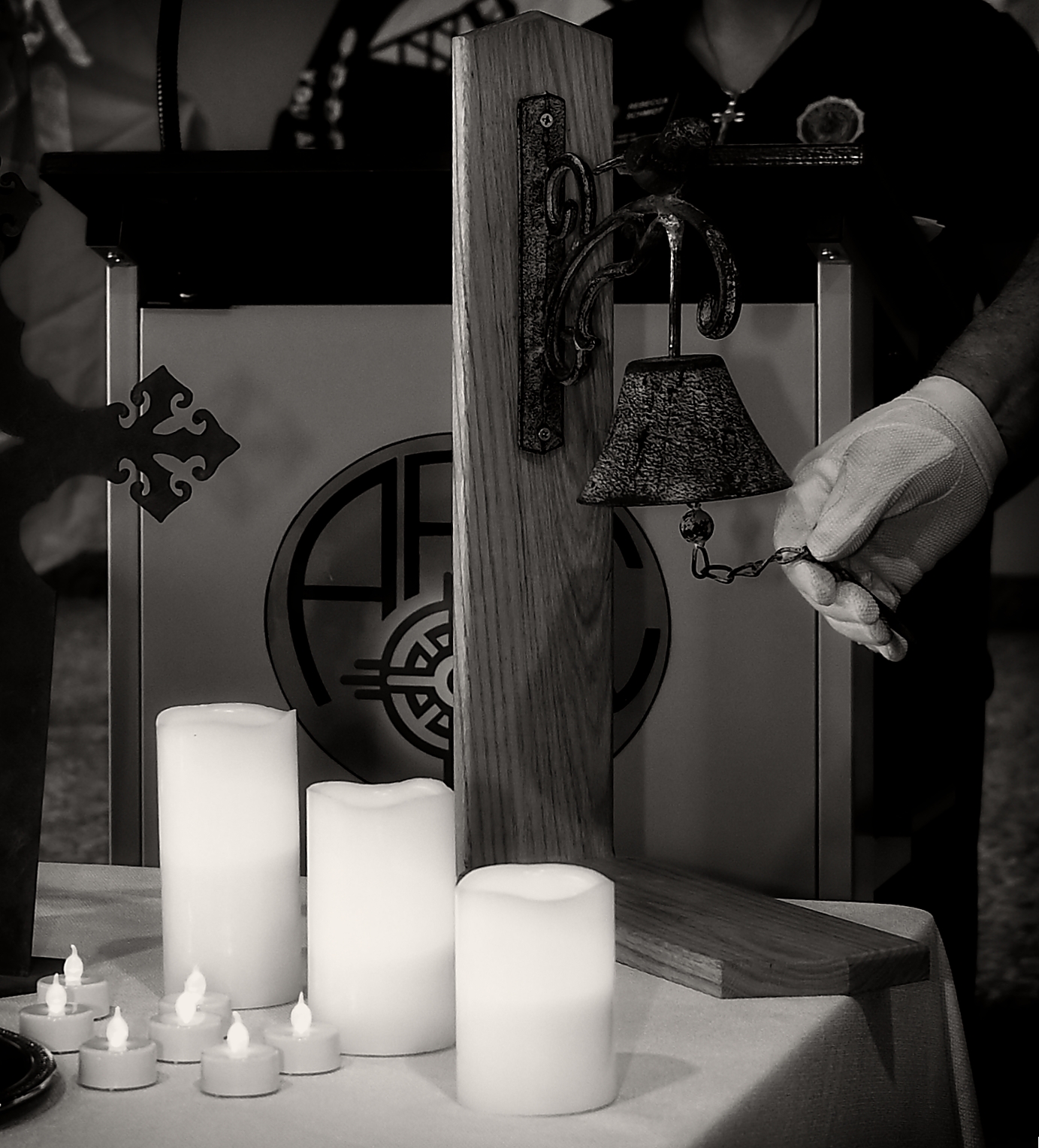
“Across the country, May is an important month of remembrance which culminates in the Memorial Day holiday and tribute ceremonies. American Legion Post 64 continued with its annual tradition of holding an Honor and Remembrance Service during our May 17th member meeting. This year we rang the bell and called out the names of ten post and auxiliary members who passed away in the last year. This experience was especially impactful for me, since I participated in an honor guard ceremony and penned tribute articles for three of the deceased veterans. It was a simple, solemn and touching ceremony that gave our fellow legionnaires and auxiliary members the honor and respect they deserve. The meeting room was tastefully set up with a remembrance table of photos, programs and red roses for the family and friends of the deceased. In front of the lectern was an honor table with a beautiful wrought iron cross, candles, a Bible, a Koran and a yarmulke. Red poppies stood out brilliantly against the white tablecloth and added the strong and significant symbol of loss, sacrifice and hope.”

Photo by Steve Smull

Why I Served and What’s Important

As I reflect on Women’s History Month, I wish I had met and been able to talk to my grandmothers. They were born around the turn of the last century and passed away long before I was born in the late 1960s.

From the stories passed down from my parents, aunts and uncles, my grandmothers were strong, stoic, and determined women who endured great hardship, made sacrifices, and cared of their large families during a difficult time in U.S. history.

Both my grandmothers saw most of their sons head off to war in Europe and Asia during the Second World War. 

My paternal grandmother, Elise

Below is an excerpt from chapter 6 of my book Strong Words and Simple Truths: The Courage to Communicate.  The theme of the chapter is Veterans and Remembrance- The Strong Man.

“The first veterans I admired were my father, uncles, and cousins that served in the U.S. Military. Most of them, my dad included, were deployed across the globe to fight for freedoms during World War II. Their strength and resolve inspired me to become a leader and a servant to others. They were my role models of what it meant to be an American.

The idea of selfless service was instilled in me at an early age as I watched my parents and my dear cousins Joey, Patty, and Richie, volunteer for countless events at the local Veterans of Foreign Wars (VFW). Although my small hometown was only a few square miles, it was home to not one but two veteran organizations—The American Legion and the VFW. Every year when I was growing up, our town would have a Memorial Day parade that concluded at one of these two posts. In my family, Memorial Day was a special day marked by a solemn remembrance ceremony in the local cemetery. 

My time on active duty in the U.S. Army in the early 1990s was relatively short and painless, but it left a lasting imprint on my perspective, leadership style, and values.

The veterans I have encountered have a strong sense of integrity and commitment to their families, friends, and community. They are a tough and resilient lot who are some of the most kind, generous, and boisterous people I know. “

Why did I join the US Army?

I’m not sure what possessed me to wander into the Army ROTC building on the college campus of Rutgers University at the end of my freshman year, but I filled out an application for an ROTC scholarship on the spot and quickly received word that I’d been accepted into the program that would commission me as a 2nd Lieutenant once I graduated.   I didn’t tell my parents what I was doing until after I was accepted.  They were both excited and happy for me.  I was the 4th out of 5 children and the only one to graduate college and serve in the military.  My strong, supportive mother, who was a civilian, inspired and motivated me to reach for the stars.

Looking back, I think there were three primary reasons why I signed up for military service in 1986.  One was to help my parents with the cost of my college education, the second was my desire to see the world, and third was the sense of duty to my country that my family instilled in me.  

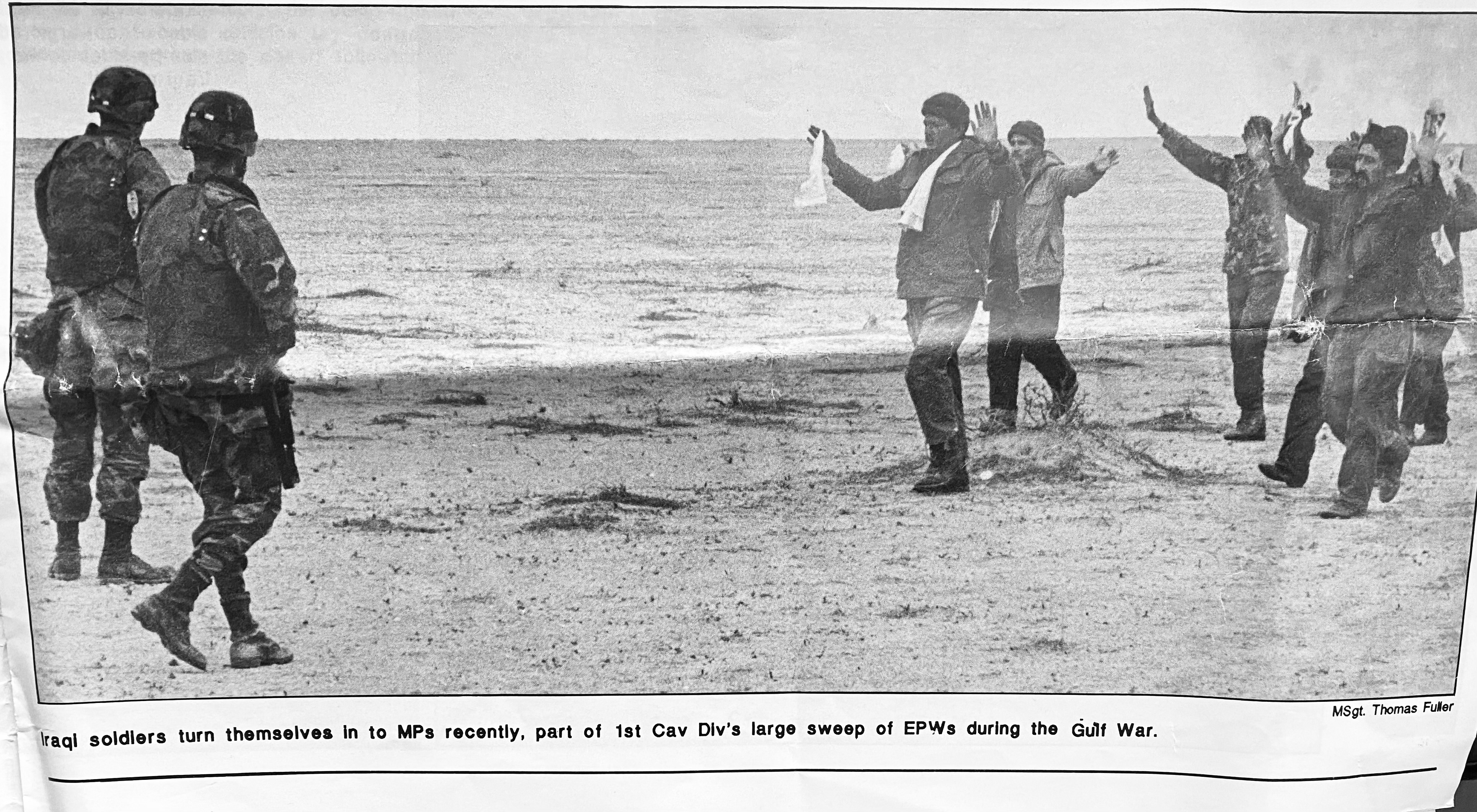
I served as a Signal Platoon Leader with the 1st Cav Division during the Gulf War and spent 10 months in the middle of nowhere in northern Saudi Arabia and southern Iraq.  My platoon consisted of 70 soldiers and our mission was to establish mobile communications for the tanks and command Humvees in the division.

Me in Iraq in March 1991

What is important to me now?

Assisting and advocating for our veterans, like my parents did, has been my top priority for last 30 years.   The incredible amount of civilian support I received made my transition out of the military easier and less traumatic.  Positive veteran champions surrounded me and gave me the encouragement and tools I needed to succeed in my corporate career.  Having employers that understood, appreciated, and leveraged my military skills truly helped to enhance and propel my business advancement.  

I continue to be active in veteran organizations like the American Legion where I strive to keep my parent’s sense of Selfless Service alive in the community. 

Supporting companies like Vanguard Veteran whose mission to equip civilians to become veteran champions is important to me as I look to expand my involvement in community and veteran outreach programs.

Now, more than ever, it is vital that we remember and honor those who have come before us and sacrificed for our rights and our freedom.   I am sure that my grandmothers and my parents would be smiling with approval.

At a VFW in Denver, CO. Photo by Steve Smull

1st CAV in the Desert

I served as a Platoon Leader in the 13th Signal Battalion, 1st Cavalry Division during the first Gulf War. We deployed from Ft Hood, TX in October 1990 to Saudi Arabia and then Iraq for the short ground war in February 1991.

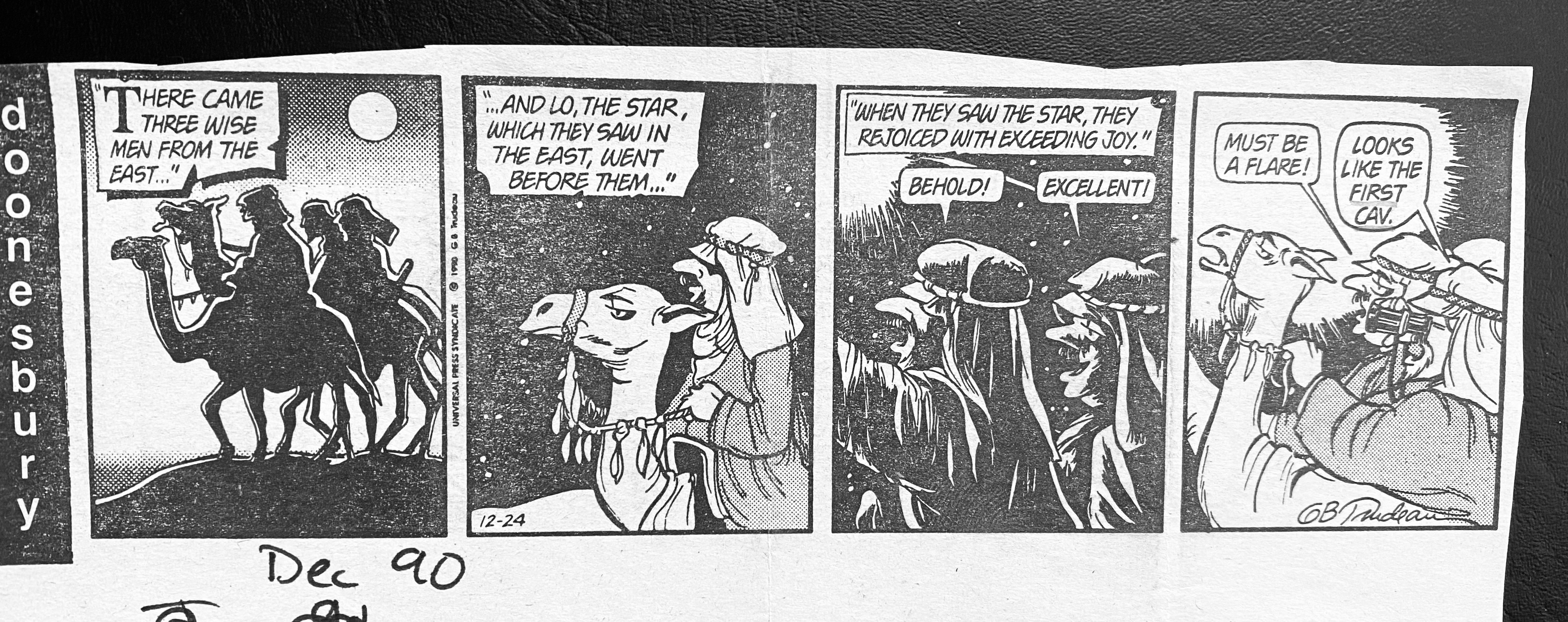
At age 23, it was strange and unsettling to spend Christmas away from my family and in the middle of the desert. The night skies were amazingly dark and full of more stars than I had ever seen. The occasional camel sighting did remind we of the three wise men headed to Bethlehem.

The last panel in Doonesbury cartoon below made me laugh. I found this newspaper clipping in my journal from 1990. I didn’t remember having it and probably haven’t seen it in over 30 years.

I was recently interviewed for the Rutgers Oral History Archives about my experience. Below is an excerpt from the transcripts.

KR:  At the end of your first interview, we left off talking about Operation Desert Storm.  What I would like to ask you about first today is, what are your recollections of Operation Desert Storm and the invasion of Iraq? 

BS:  I think the biggest memory and impact was in January of 1991.  We had been in Saudi Arabia since October, just sitting, waiting for the invasion.  We were in northern Saudi Arabia.  I just remember when the ground war kicked off.  We didn’t have any news.  We didn’t have TV or radio like have today, but I do remember seeing and hearing these–they were called MLRS [multiple launch rocket system]–these rockets, and they went off many at a time, and the lights, just watching these rockets take off, knowing they were going north into Iraq as we attacked, and just thinking, “Wow, how much destruction and/or death is occurring at the end of that?”  It was really bizarre and surreal, but that was the only thing I remember and I saw at the time.  It was scary that first night.  We didn’t know if we were going to get attacked with Scud missiles that had chemical or nuclear/biological weapons.  We were mostly scared of chemicals at the time, but it could have been biological.  [Editor’s Note: On January 17, 1991, U.S. and coalition forces launched Operation Desert Storm with a campaign of air and missile attacks on targets in Iraq and Kuwait.]

I do remember the first night, and that was really the only night that I slept in my mask, my gas mask, and the full protective gear.  It wasn’t too hot.  It was January, luckily.

KR:  Were there any religious services when you were in Saudi Arabia or Iraq?  Were there chaplains around to do religious services or counseling? 

BS:  In Saudi Arabia, we were told to not have any outward displays of religion, Christianity, Judaism.  We did, in our tents, have some Christmas [trees], but, again, it wasn’t [extensive].  There were chaplains, but, again, they were told to not put their insignia on their uniform.  As I recall, the officers that were chaplains would have their rank on one side and then you would have your unit on the other, but I think they had either a cross [or] Star of David, and they were told to cover those.  I don’t recall ever talking to a chaplain, seeing them.  I suppose, if it was needed and someone needed counseling, we could have called into the DMAIN, the centralized rear command, and asked for it, but we didn’t need it.  The same for doctors and nurses and medical.  I’m sure these support units were there if we needed them, but I didn’t interact with them either.  We were forward operations. 

For women, we were in the frontlines with our communication vans.  In fact, there were Iraqi soldiers surrendering to some of the units that were in my platoon, and it was a woman that they surrendered to.  She was the sergeant of this little remote radio tower.  It was her and three other soldiers who were men, but Iraqi soliders surrendered to them.  For me, I was like, “Wow, a Muslim man from Iraq just surrendered to a woman, an American woman.”  That was kind of interesting. 

KR:   My next question you have touched upon a little bit in some other questions that we have asked you.  Once Operation Desert Storm was being launched and the invasion of Iraq, what were your experiences like and the experiences of your unit? 

BS:  Once the big launch in January occurred, we left our base, where we had been for many months in northern Saudi, and we convoyed north into southern Iraq.  We left in the middle of the night.  I just remember driving in this huge–it was a deuce and a half–a two-and-a-half-ton truck, very, very uncomfortable, for hours just driving north (20+ hours), but it was pretty exciting, because we knew this was the big thing we’d been waiting for. We’re traveling, and it’s exciting because we’re seeing other tanks and units from Britain and other countries alongside us traveling in the same direction.  Then, we got to a location, and we stopped.  This was where we were going to set up our communications.  I only have one picture from the whole war.  There was a burned-out military–it looked like a tank and it was an Iraqi tank and there were dead Iraqi soldiers on the ground.  It was taken out by a U.S. missile or an Apache.  My soldiers had to call and get body bags and put them in.  I made a decision that I didn’t want to see the bodies, the corpses, because I didn’t want it to stick in my mind.  I didn’t go near it, but we set up camp maybe a hundred meters away from that.  It was kind of creepy to be there.  We were there thirty, forty days.  We stayed there, and it wasn’t long before we won the war decisively.  We were all told, “Okay, time to go home now.” 

More stories and memories to come in my next blog.